
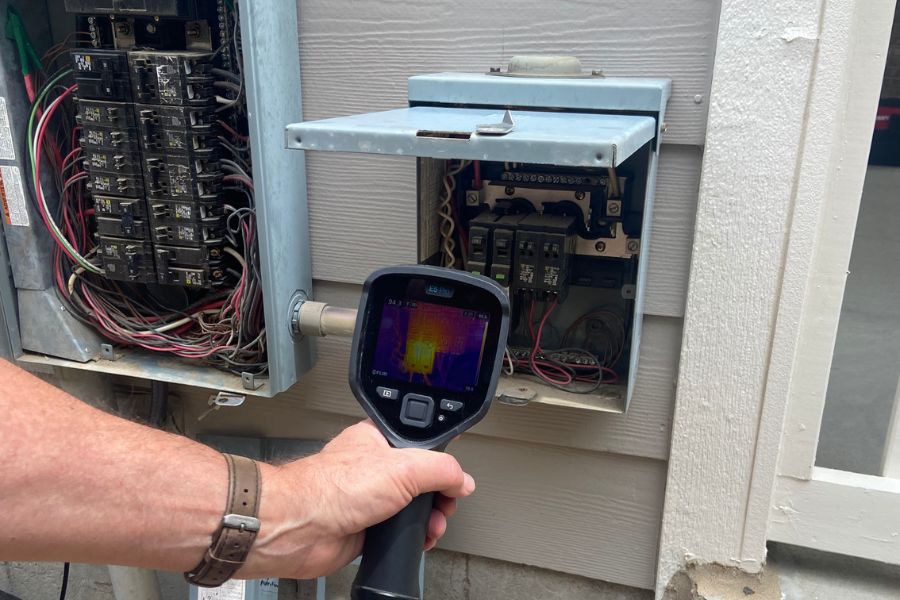
A lot of what we look for during a home inspection can be seen with the naked eye. But sometimes, a difference in temperature can help point us toward something that deserves a closer look.
That’s where thermal imaging comes in.
A thermal imaging camera allows us to see temperature patterns across surfaces and components throughout a home. Those patterns can provide additional information about things like moisture, insulation, electrical components, and heating systems that may not be immediately obvious during a visual inspection.
But thermal imaging isn’t X-ray vision, and a colorful spot on the camera doesn’t automatically mean there’s a problem. Here’s what thermal imaging can actually show us during a home inspection.
How Does Thermal Imaging Work During a Home Inspection?
Thermal imaging cameras detect differences in surface temperature and display those differences as an image.
Depending on the temperature scale being used, warmer areas may appear yellow, orange, or red, while cooler areas may appear purple or blue.
The important thing to remember is that the colors themselves don’t tell us whether something is wrong.
A bright orange area isn’t automatically a problem, just like a dark purple area isn’t automatically a leak. What matters is the temperature difference, where we’re seeing it, and what else is happening in that part of the home.
That’s where the inspector’s experience comes in.
What Can Thermal Imaging Help Identify?
During a home inspection, thermal imaging can provide additional information about several areas of the home, including:
- Electrical hot spots and unusual temperature differences around electrical components
- Missing or inconsistent insulation in walls and ceilings
- Possible moisture intrusion that may warrant further investigation
- Heating and HVAC performance, including temperature patterns around registers and radiant heating systems
A thermal image doesn’t diagnose any of these problems on its own. Instead, it gives the inspector another piece of information to consider alongside visual observations and other inspection tools.
Electrical Hot Spots
Electrical components generate some heat during normal operation. But an unusual temperature difference can sometimes indicate a condition that needs a closer look.
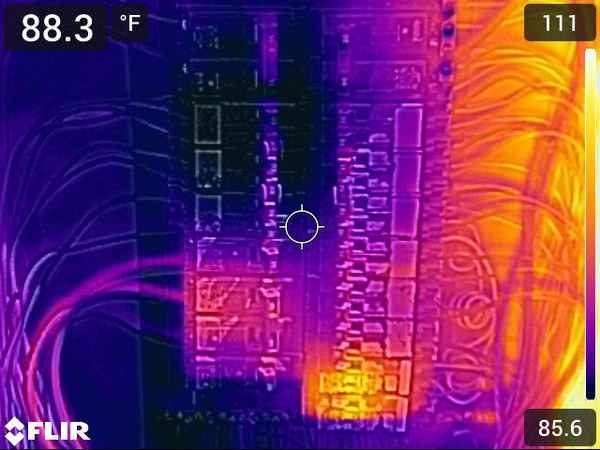
For example, thermal imaging may show that one area of an electrical panel is considerably warmer than the components surrounding it. This could be normal, such as heat produced by a GFCI or AFCI breaker or a breaker carrying a larger electrical load. However, it could also indicate a loose connection, an overloaded circuit, or another electrical issue creating excess heat.
That doesn’t mean the thermal camera has diagnosed an electrical problem. Instead, it gives us another piece of information to consider alongside what we can see during the rest of the electrical inspection.
Missing or Inconsistent Insulation
Temperature differences along walls and ceilings can also help us identify areas where heat is transferring differently than expected.
Depending on the conditions, an unusual pattern may point toward missing, displaced, or inconsistent insulation. These are the kinds of issues that can be difficult, or sometimes impossible, to spot just by looking at a finished wall or ceiling.
Possible Moisture Intrusion
This is one of the areas where it’s especially important to understand what a thermal camera can and can’t tell us.
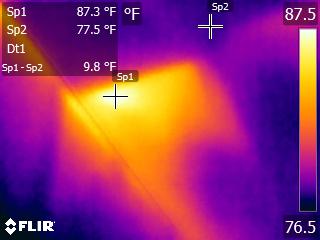
Thermal imaging does not directly detect water. However, active moisture can sometimes cause a surface to have a different temperature than the materials around it.
If we notice an unusual temperature pattern in an area where moisture could be a concern, that gives us a reason to investigate further. We can then look for other signs of moisture and use tools like a moisture meter when appropriate.
In other words, the thermal image can help point us in the right direction, but it isn’t enough on its own to say, “There’s a leak behind this wall.”
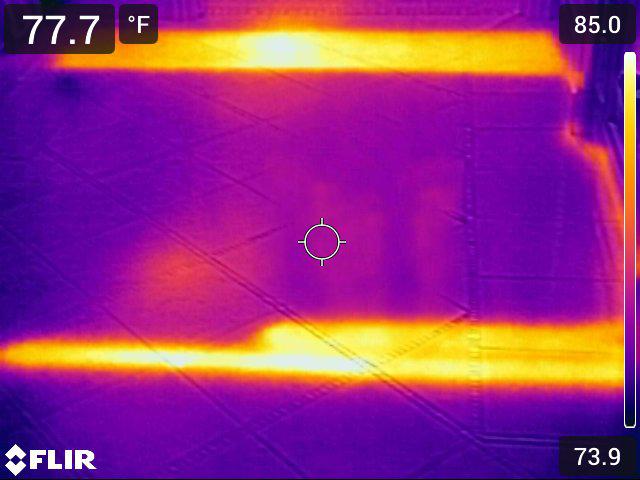
Heating and HVAC Performance
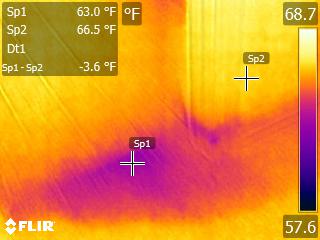
Thermal imaging can also help us visualize how heating and cooling systems are performing.
For example, we may be able to see temperature patterns around HVAC registers or radiant heating systems that help us determine whether heat is being distributed as expected.
If one area looks noticeably different from the others, we can take a closer look at what may be causing it.
What Can’t Thermal Imaging Detect During a Home Inspection?
Thermal imaging is a useful tool, but it has limitations. A thermal camera can’t:
- See through walls
- Detect conditions hidden behind furniture or personal belongings
- Definitively diagnose a plumbing or roof leak
- Detect mold
- Tell us exactly what’s causing every temperature difference
- Replace moisture meters or other inspection tools
- Replace further evaluation by a qualified professional when needed
That’s why we don’t rely on thermal imaging alone.
If we see an unusual thermal pattern, we consider it alongside the rest of the inspection. Where is it located? What’s on the other side of that wall or ceiling? Are there visible signs of a problem? What are our other tools telling us?
Sometimes the answer is completely normal. Other times, it gives us a reason to investigate further or recommend additional evaluation.
Why Experience Matters When Using Thermal Imaging
Thermal cameras can provide useful information, but owning the equipment isn’t the same thing as knowing what you’re looking at.
A temperature difference could be related to moisture, insulation, air movement, an electrical component, a heating system, the way the home was constructed, or simply the conditions at the time of the inspection.
The goal isn’t to find the brightest or darkest spot on the screen and call it a defect. It’s to understand why that temperature difference may be there and whether it matters.
Thermal imaging gives us another way to gather information about a home and, when something doesn’t look right, another reason to take a closer look.
Get a Better Understanding of the Home You’re Buying
At Quality Building Inspections, we use tools like thermal imaging alongside a thorough visual inspection to help you better understand the condition of your home.
When we find something unusual, we’ll show you what we’re seeing, explain what it could mean in plain language, and let you know when further evaluation may be appropriate.
Schedule Your Home Inspection